Navarrabiomed’s Microbial Pathogenesis Unit Develops Synthetic Bacteriophages to Combat Staphylococcus aureus Infections
This innovative preclinical study specifically destroys the chromosome of Staphylococcus aureus, one of the world’s most dangerous and antibiotic-resistant bacteria.
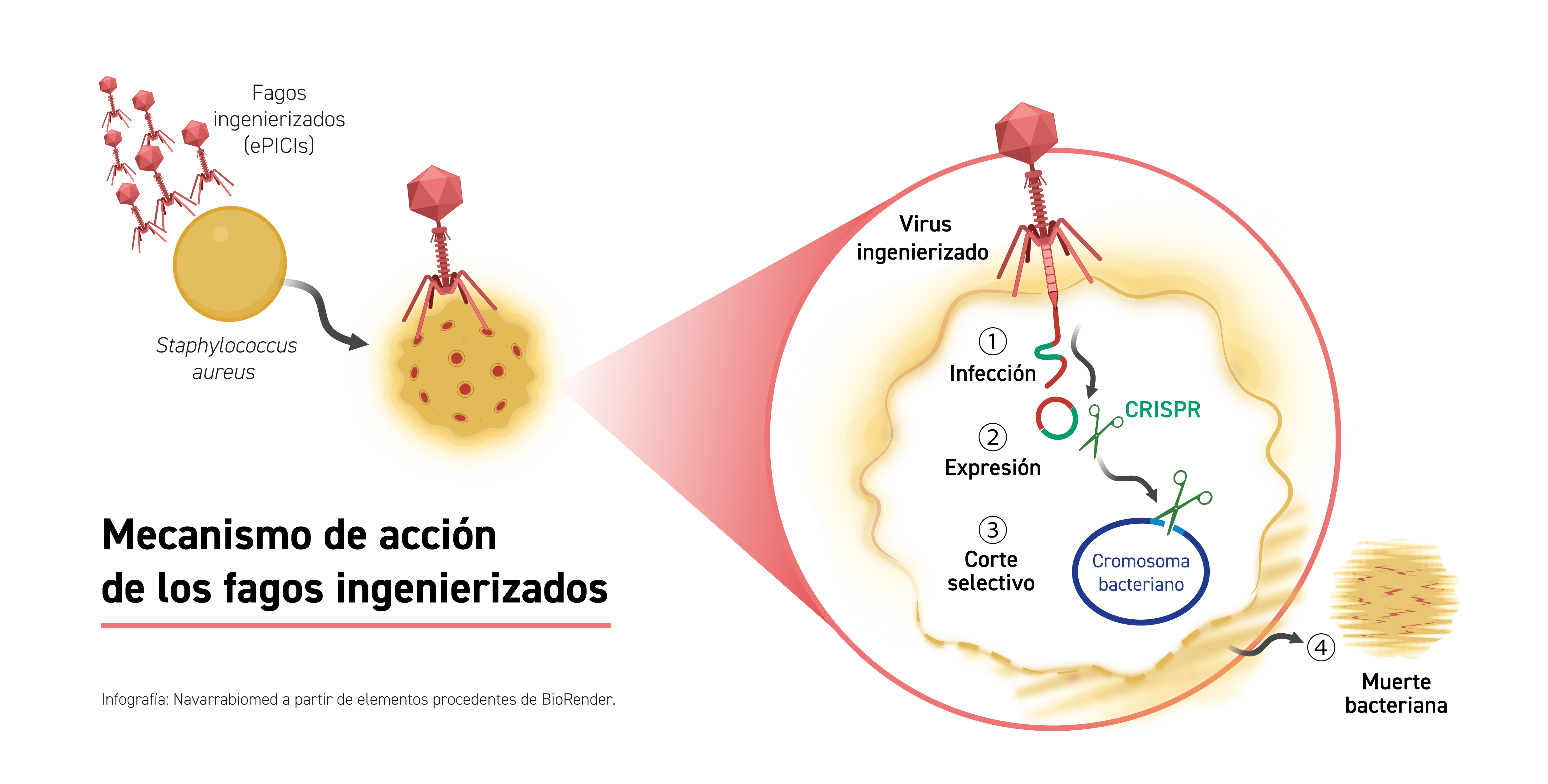
The Microbial Pathogenesis Unit at Navarrabiomed-UPNA has developed an innovative antimicrobial strategy capable of eliminating infections caused by Staphylococcus aureus, a bacterium associated with more than one million deaths worldwide each year. The innovation, currently at the preclinical stage, is based on the genetic modification of viruses to act as “Trojan horses,” entering exclusively into Staphylococcus aureus cells and destroying them from within, without affecting the other microorganisms that make up the body’s microbiota.
The research, published in npj Biofilms and Microbiomes and funded by the Spanish Ministry of Science, Innovation and Universities, involved multidisciplinary work combining molecular microbiology, synthetic biology, and experimental mouse infection models. The study was led by Dr. Íñigo Lasa, Principal Investigator of the Microbial Pathogenesis Unit at Navarrabiomed and Professor at the Public University of Navarra (UPNA). The work was carried out primarily by Nahiara Garmendia-Antoñana and Pedro Dorado-Morales, with the collaboration of José R. Penadés, Head of the Department of Infectious Disease at Imperial College London.
Research Impact
Staphylococcus aureus is a very common bacterium that colonizes the skin and nasal passages of approximately 30% of the adult population. However, once it breaches the epithelial barrier, it becomes an extraordinarily versatile pathogen. For this reason, the international scientific community is engaged in a race against time to develop precision antimicrobials capable of effectively targeting it.
The Navarrabiomed study uses synthetically engineered bacteriophages, viruses that specifically infect Staphylococcus aureus. These viruses carry the CRISPR gene-editing system, acting as molecular scissors programmed to cut the genetic material of the bacterium. The viruses are completely harmless to humans because they are unable to infect human cells. To date, the therapy’s effectiveness has been demonstrated in experimental models of mastitis (an infection of the mammary gland that commonly affects both animals and women). In these models, the new treatment proved to be as effective as vancomycin, one of the most powerful antibiotics currently available for treating infections caused by Staphylococcus aureus.
Íñigo Lasa, who led the research, highlights the significance of this therapeutic approach:
“One of the major advantages of this strategy is its extremely high precision: it targets only Staphylococcus aureus at the site of infection without affecting the rest of the body's bacterial communities. This represents a key difference from conventional antibiotics, which generally act indiscriminately and also destroy bacteria that perform essential functions for human health.”
A Global Clinical Threat
The World Health Organization (WHO) considers Staphylococcus aureus one of the major threats to global public health because of its remarkable ability to evade conventional treatments. One of the bacterium’s greatest dangers is its capacity to adhere to surfaces and form biofilms: protective layers that can make it up to 1,000 times more resistant to antibiotics and immune-system defenses. Standard treatment typically relies on antibiotics such as vancomycin or daptomycin. However, when resistant strains emerge, therapeutic options can become severely limited.
Risk factors for developing serious Staphylococcus aureus infections include hospital surgeries, medical implants, open wounds, trauma, chronic diseases, and weakened immune systems. In maternal and child health as well as veterinary medicine, the bacterium is also associated with mastitis during breastfeeding.
Another reason why Staphylococcus aureus infections are becoming increasingly common is the ageing population and the growing use of prosthetic devices and implants. In such cases, the bacterium can colonize the implant surface and cause chronic infections that are often resolved only through the removal of the contaminated prosthesis and its replacement with a new one.