

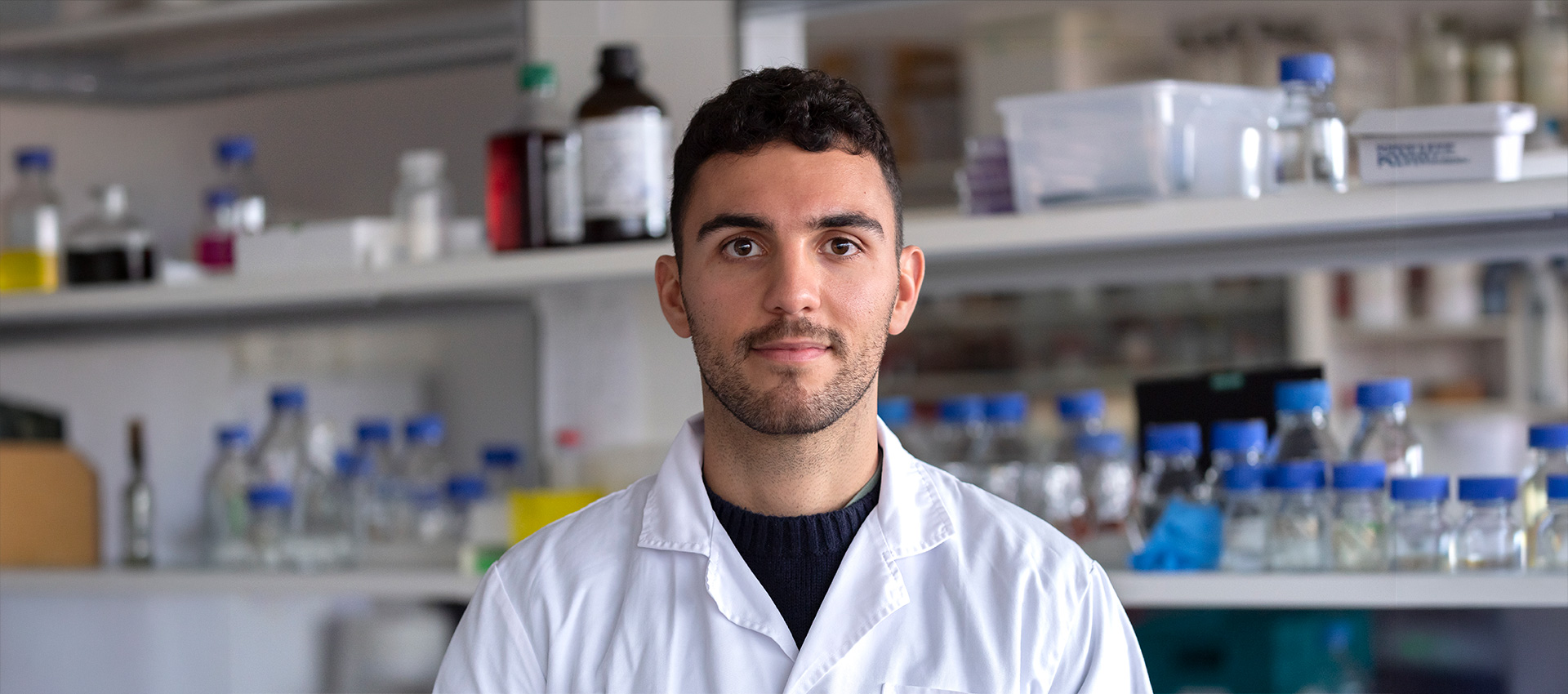
Álvaro San Martín will Defend His Doctoral Thesis on Friday, 13 November
Álvaro San Martín Bernal, a predoctoral researcher in the Microbial Pathogenesis Unit at Navarrabiomed, will defend his doctoral thesis at the Public University of Navarre (UPNA) on Friday, 13 November 2026, at 12:00 pm in the assembly hall of Navarrabiomed.
The doctoral thesis, entitled “New Tools to Evaluate the Regulatory Role of Transcriptional Overlap in Bacteria”, has been carried out under the supervision of Dr. Iñigo Lasa Uzcudun, Principal Investigator of the Microbial Pathogenesis Unit at Navarrabiomed, and Dr. Jerónimo Rodríguez Beltrán, Principal Investigator in the Microbiology Unit at Hospital Ramón y Cajal - IRYCIS (Madrid).
Research Overview
Bacterial genomes are highly compact, with genes often positioned so closely together that the RNA molecules they produce overlap. This phenomenon is especially common when neighboring genes are oriented in opposite directions. Such gene pairs can form structures known as excludons, which act as genetic switches: when the activity of one gene increases, the activity of the other tends to decrease.
Until now, excludons had only been identified individually and largely by chance, leaving many questions unanswered regarding their prevalence across bacterial species and their biological functions. To enable the systematic and objective identification of excludons, Álvaro San Martín developed ExcludonFinder, an open-access computational tool capable of detecting excludons across complete genomes using RNA sequencing (RNA-seq) data. In addition, he created an automated platform for analysing large-scale public datasets available in scientific repositories.
Using these technologies, he generated the first comprehensive maps of excludons in two medically important bacteria, Escherichia coli and Staphylococcus aureus. The findings were validated using independent approaches, including single-cell transcriptomics, double-stranded RNA-binding protein immunoprecipitation, and small RNA transcriptome analyses.
The study subsequently identified 26 shared excludons and a total of 149 distinct excludons across nine E. coli strains. These findings suggest that differences between bacterial strains are determined not only by the genes they possess, but also by how their transcripts are defined and expressed. Furthermore, excludons were found to be evolutionarily conserved and frequently associated with transcription factors and toxin-antitoxin systems, two key mechanisms involved in bacterial stress responses and environmental adaptation.
Overall, this work demonstrates that transcriptional overlap between neighboring genes, through excludons, represents a previously underappreciated and widespread layer of genetic regulation in bacteria. The study also paves the way for exploring this phenomenon in other microorganisms, including archaea and bacteriophages, and for uncovering novel functional relationships between adjacent genes.
Mobility Grant and Publications
During his doctoral training, Álvaro San Martín received a “César Nombela” Mobility Grant awarded by the Spanish Society for Microbiology.
The results of his research have been published in the journals Nucleic Acids Research, Frontiers in Cellular and Infection Microbiology, and microLife. In addition, his work has been presented at several international and national scientific meetings, including:
Federation of European Microbiological Societies Congress (FEMS MICRO), Milan, 2025
30th Congress of the Spanish Society for Microbiology, Spain, 2025
14th Molecular Microbiology Meeting, Santander, 2024