Noticias

Influence of genetic and immunologic factors identified in 15% of severe COVID-19 patients

Author
Navarrabiomed
  • An international study involving the participation of CHN and Navarrabiomed has shown that these patients present abnormalities that affect the interferon pathway, a crucial system for defending against the virus.


The international collaborative study COVID Human Genetic Effort (COVIDHGE), in which the Hospital Complex of Navarre (CHN) and the Navarrabiomed Clinical Trials Platform took part, has shown that genetic and immunologic factors that affect the severity of the disease are found in approximately 15% of severe cases of COVID-19. These cases are directly linked to the malfunctioning of the protein type I interferon pathway.

Interferon is a protein produced by the immune system. Its function is to signal other immune cells about the presence of viruses. Abnormality in this molecule is due to genetic or immunologic factors that prevent the body’s cells from defending themselves against the coronavirus, which may leave the patient in a severe clinical condition.
Thanks to this global collaborative effort, which includes CHN patients, it has been possible to use genome analysis to identify innate errors in type I interferon-mediated immunity in the genome of 23 out of 659 patients with severe pneumonia caused by COVID-19 who presented no prior severe disease (3.5%), compared to a control group of 534 individuals with asymptomatic or benign infection. In these 23 patients, researchers found 6 genetic defects known to be associated with risk of severe viral infection, although none of these people had been ill until the arrival of SARS-CoV-2. Four genetic defects were also found that were unknown to date and that are behind the severe symptoms suffered by these people when exposed to the new coronavirus.

Moreover, the consortium found that 101 of 987 patients aged between 25 and 87 years with a severe form of COVID-19 (10.2%) presented antibodies to their own interferon from the onset of the infection or even before, compared to just 4 out of 1227 people in the general population (0.33%) and none of the 63 patients studied with mild COVID-19. In vitro studies have shown that these antibodies neutralize the blocking action of type I interferon against SARS-CoV-2.

We know that there is considerable variability among infected individuals, ranging from asymptomatic infection to fatal pneumonia due to COVID-19. It is known that men tend to be at a greater risk of severe complications than women and that the probability of severe illness increases notably in the elderly and in patients with pre-existing conditions, such as high blood pressure, cardiovascular and respiratory diseases, diabetes and obesity. In this collaborative study, the COVIDHGE consortium has found that the presence of these anti-interferon antibodies is much more common in men than in women with a severe form of COVID-19 (12.5% vs. 2.6%), and that the probability increases with age. This helps researchers understand part of this variability between individuals with severe SARS-CoV-2 infection.

Genomic Medicine Applied to COVID-19

The results recently published in two articles in the journal Science partially solve the mystery of why some young, healthy people suffer severe COVID-19 by linking incidence to genetic and immunologic factors. These factors can result in admission to the ICU and even death. In fact, in the group of patients with anti-interferon antibodies, mortality was 36.6% (37 out of 101 patients).

The research involved the participation of Dr. Sergio Aguilera, a pediatrician and neuropediatrician at the CHN Pediatrics Department, who is the coordinator of this study at CHN and Navarrabiomed in collaboration with Dr. Aurora Pujol, a geneticist with IDIBELL (Barcelona) who networks with COVIDHGE. The Rockefeller University in New York and Necker Hospital in Paris led this consortium, which includes more than 50 genome-sequencing centers, research groups, and hundreds of hospitals around the world.

The work provides evidence of the susceptibility of some people to suffering a severe SARS-CoV-2 infection, even though previously healthy and without having suffered any other previous relevant infections. “These findings will make it possible to more accurately select candidates for the different clinical trials in progress to assess the utility of treatment with interferon or blockers of these antibodies, aimed at counteracting the consequences of these genetic and immunologic factors involved in some severe forms of COVID-19”, said Dr. Aguilera.

More than 250 patients were recruited from several hospitals in Spain, including the following: CHN in Navarre, Hospital Infanta Leonor and Clínica Universidad de Navarra in Madrid, Hospital Universitario de Burgos in Burgos, and Hospital del Mar and Hospital Universitario de Bellvitge in Barcelona. The National Center for Genome Analysis took part in sequencing the patients’ genomes.
 

Categoría
Documentación

Government of Navarre awards €23 million in grants to strategic agri-food R&D and investment projects

Author
Navarrabiomed
  • The grants will go to 59 companies in the agri-food sector and to ten strategic R&D projects in line with Navarre’s Smart Specialization Strategies (S3)

The Government of Navarre’s Ministry of Economic and Business Development recently released the results of two calls for grant applications for the amount of €23 million. Specifically, it approved €13 million in grants to strategic R&D projects in line with the S3 and another €10 million to investments in agri-food industries in Navarre, as announced by Minister Manu Ayerdi at a press conference today.

An investment of €72 million in SMEs and micro-SMEs and an anticipated 256 new jobs

The Ministry of Economic and Business Development organized a specific call for applications in the agri-food industry and awarded grants to expenditures made before 1 December 2020, rather than to specific future projects. For these grants, applications were accepted to acquire machinery, build new facilities and remodel existing premises.

A total of 59 companies benefited from €10 million in financial aid. The lion’s share of the recipients (74%) were SMEs and micro-SMEs. The grants can be broken down as follows: 37 went to SMEs (eight of which were cooperatives) and seven to micro-SMEs, compared to 15 to large companies.

A further breakdown by subsector shows that €4.6 million was awarded to a total of 19 companies working with fruits and vegetables; €2.4 million went to 12 cereal companies; and €1.5 million was earmarked for 16 companies in the meat industry. Five companies in the dairy industry were awarded €448,388, and three olive oil production firms received €532,469.

Taken together, the winning projects were awarded a total of €72.8 million and are expected to create 256 new jobs.

By geographic area, most of the grants went to companies located in the middle and southern areas of Navarre. Many of the recipient firms (21) operate in the Ribera and Ribera del Ebro area. The County of Pamplona is home to another nine firms while seven companies are located in the Ribera Arga-Aragón area. The Navarra Atlántica, Tierra Estella and Zona Media areas boast six grant recipients each. Two companies are located in Baztan and another two have their head offices in the Pyrenees area. Furthermore, of the 59 successful applicants, 11 are located in towns with a population of less than 1,000 inhabitants. The eligible investment amounted to €12,812,857 (17.59%) and grants were awarded for €1,784,366.01, thus covering 17.68% of the total eligible investment.

€13 million for strategic R&D projects

Strategic R&D projects were awarded grants for a total of about €13 million, based on the Ministry’s goal of promoting the implementation of initiatives with a high impact on Navarre’s priority industries, as stipulated in the S3 Smart Specialization Strategies. In this case, the government gave high priority to projects undertaken jointly by companies and research organizations in order to address the different challenges Navarre must face. Forty-one companies and 24 technology and research centers will collaborate on ten scheduled projects.

For example, grants were awarded to three projects on genomics and advanced medicine. The largest of the three is the NagenPedriatrics project, which is promoted by Nasertic, the Miguel Servet Foundation and the company Avalon Tecnologías. The project aims to carry out advanced genome sequencing in pediatrics. This initiative received a grant for €1.99 million. The LINTERNA Project (Leadership and Innovation in Cancer Immunotherapy in Navarre) will receive €1.76 million and will be developed by the ADItech Foundation, Medibiofarma, the Miguel Servet Foundation, the Foundation for Applied Medical Research and the Universidad de Navarra. Finally, AGATA (Alliance in Advanced Genomics for the Development of Personalized Treatments) was awarded a grant for €1.52 million. The AGATA Project is promoted by the Miguel Servet Foundation, the Universidad de Navarra, Nasertic, Recombina and the Foundation for Applied Medical Research.

Food and artificial intelligence

In the area of personalized nutrition, an €841,529 grant was awarded to the Nutri+ Project: making progress on nutrition for people with special needs. The consortium that promotes this initiative is made up of the Miguel Servet Foundation, the National Center for Food Technology and Safety (CNTA), the Universidad de Navarra, Adacen, Tutti Pasta, Industrias Alimentarias de Navarra, Precocinados Frisa, Cocuus System Ibérica, the ADItech Foundation and SAR Residencial y Asistencial.

In artificial intelligence and robotics, the Government of Navarre aims to use these grants to promote three new initiatives. It awarded €813.349 to the ReInforce Project. This AI platform for predicting cancer toxicity and recurrence is backed by the Fundación I+D+i Automoción y Mecatrónica, the Universidad de Navarra and the companies Datbowmovalsys, Cistec, Eversens and Aldakin. A grant of €704,419 was awarded to the project Artificial Intelligence for Chipless RFID, promoted by the Universidad Pública de Navarra (UPNA), the Fundación I+D+i Automoción y Mecatrónica, and the companies Ulzama Digital, Ulzama Packaging, Embeblue, Innavatic and Gráficas Ulzama. The initiative AIFood was awarded a grant for €804.408 to start up a quality control and food safety monitoring and decision-making platform. In this case, the project was presented by a consortium made up of the UPNA, Association of Industry of Navarre (AIN), CNTA, and the companies Florette, Urzante, Helphone, Das Nano and IAR.

Finally, in the area of emerging disruptive ideas, a grant for €1.74 million was awarded to the Innolfact project, which aims to implement precision nasal medicine and develop nasal treatments with immunomodulators, especially in cases of aging and people with neurodegenerative diseases. The ADItech Foundation, the Miguel Servet Foundation and the Foundation for Applied Medical Research are backing this proposal, along with the Universidad de Navarra and Ojer Pharma Laboratories.
The Emotional Films project and study on applications in teaching, psychology and other fields, with the participation of the ADItech Foundation, was awarded a grant for €1,588,970.

The goal of the 3D3B-AVATAR project is to generate a 3D model of the human blood-brain barrier that reproduces characteristics in terms of structure, function and fluid dynamics in a patient with Alzheimer’s disease. The project was awarded a grant of €1,299,279 and will enjoy the participation of the UPNA, the Fundación I+D+i Automoción y Mecatrónica, the Foundation for Applied Medical Research, the Miguel Servet Foundation, and the companies Hirudi Sistemas 3D, Iruña Tecnologías de Automatización and One Voxel.
 

Categoría
Documentación

“la Caixa” Foundation and Francisco Luzón Foundation to fund Navarrabiomed and CHN project to search for ALS biomarkers

Author
Navarrabiomed
  • Led by Dr. Maite Mendioroz Iriarte and Dr. Ivonne Jericó Pascual, the research project was awarded €482,847 in funding

The annual call for health research projects organized by “la Caixa” Foundation and the Francisco Luzón Foundation singled out a project that focuses on the development of a non-invasive test to detect amyotrophic lateral sclerosis (ALS), also known as Lou Gehrig's disease, and other neurodegenerative diseases, such as Alzheimer-type dementia (ATD). The project is led by Maite Mendioroz Iriarte, the principal researcher in Navarrabiomed’s Neuroepigenetics Unit, and Ivonne Jericó Pascual, a neurologist and researcher in the Neurology Service of the Hospital Complex of Navarre (CHN). The initiative has been awarded a grant of €482,847.

Early detection of ALS and other neurodegenerative diseases is a daunting task, given the impossibility of accessing the central nervous system in living patients, as explained by “la Caixa” Foundation. However, a non-invasive test known as a liquid biopsy is now available as a source of biomarkers in neurodegenerative diseases.

The aim of this project is to identify epigenetic markers in fragments of DNA in blood plasma from neurons affected by neurodegeneration and thus facilitate diagnosis of ALS and ATD. A blood test can reveal information about what is happening in the central nervous system of living patients.

Collaboration with the Universidad de Navarra

A second project selected by “la Caixa” Foundation is led by Felipe Prósper, a researcher at the Universidad de Navarra. Also collaborating on the project is David Gómez-Cabrero, principal researcher in the Translational Bioinformatics Unit at Navarrabiomed, as part of a research consortium that includes the Foundation and Center for Applied Medical Research (FIMA/CIMA), and the University of Cambridge (United Kingdom). In this case, the team will work on analyzing the production of blood to better understand the most aggressive forms of leukemia. One of the goals is to identify new treatments that target the cause of the disease. The project has been awarded €999,410 in funding.

These initiatives were chosen in the third call for health research projects from “la Caixa” Foundation, which awarded €18 million to a total of 25 projects. Since the program began in 2017, the Foundation has granted nearly €50 million to 75 research projects. “la Caixa” Foundation will open the fourth call for new project applications on 20 October 2020.
 

Categoría
Galería de imágenes
Research team of the project led by Maite Mendioroz Iriarte and Ivonne Jericó Pascual
Download Flecha que indica descarga
Documentación

Publicada la relación definitiva de personas admitidas y excluidas del Programa de ayudas Navarrabiomed 2020

Author
Navarrabiomed

La Unidad de Gestión de Navarrabiomed ha publicado hoy martes, 15 de septiembre la relación definitiva de personas admitidas y excluidas del Programa de ayudas Navarrabiomed 2020 para cada una de las convocatorias: ayuda predoctoral y ayuda postdoctoral. Puede consultar y descargar a continuación la documentación correspondiente. 

Categoría
Documentación
Programa de ayuda predoctoral y postdoctoral Navarrabiomed 2020
15/09/2020 Propuesta de adjudicación ayuda predoctoral y postdoctoral Navarrabiomed 2020
Programa de ayuda predoctoral y postdoctoral Navarrabiomed 2020
15/09/2020 Puntuaciones finales ayuda predoctoral y postdoctoral Navarrabiomed 2020
Programa de ayuda predoctoral Navarrabiomed 2020
03/09/2020 Relación definitiva de personas admitidas y excluidas
Programa de ayuda postdoctoral Navarrabiomed 2020
03/09/2020 Relación definitiva de personas admitidas y excluidas
Programa de ayuda predoctoral Navarrabiomed 2021
03/09/2021 Propuesta de adjudicación
Programa de ayuda postdoctoral Navarrabiomed 2021
03/09/2021 Propuesta de adjudicación
Vídeo

El 45% de los menores de entre 3 y 6 años realizan entre 2 y 3 horas de actividad física durante los fines de semana

Author
UPNA
  • Según los resultados del primer Observatorio de Actividad Física, financiado por Gobierno de Navarra con la participación de la UPNA, Navarrabiomed y el Departamento de Educación

El Observatorio de Actividad Física de niños y niñas de entre 3 y 6 años, puesto en marcha en Navarra en 2019, ha dado a conocer los primeros resultados de su estudio. Según los investigadores, si bien el 95% de los escolares disfruta “muchísimo” con las clases de motricidad realizadas en las escuelas, “uno de los datos relevantes es que tan solo el 45% de los niños y niñas realiza entre dos y tres horas de actividad física los sábados y los domingos, y un 15% cumple las recomendaciones para los menores de 5 años de realizar 180 minutos diarios de actividad física”.

Asimismo, “el 96% de los niños y niñas cumple con las recomendaciones que limitan a un máximo de 2 horas el tiempo de exposición a pantallas digitales y el 82% están poco o nada de tiempo sentados durante su tiempo libre, con lo que minimizan el riesgo de sedentarismo”, señalan los autores del estudio. 

El Observatorio de Actividad Física en menores de 3 a 6 años de la Comunidad Foral de Navarra es un proyecto de investigación financiado por el Departamento de Educación del Gobierno de Navarra y en el que participan investigadores del grupo Ejercicio Físico, Salud y Calidad de vida (E-FIT) de la Universidad Pública de Navarra (UPNA) y del Centro de Investigación Biomédica Navarrabiomed. El proyecto esa dirigido por Alicia Alonso (UPNA), Mikel Izquierdo y Robinson Ramírez-Vélez (UPNA-Navarrabiomed) y Antonio García-Hermoso (Navarrabiomed). 

Repercusiones del confinamiento

Los datos recogidos durante la fase de confinamiento, debido a la COVID-19, muestran que el 91% de los escolares evaluados realizó cierto nivel de actividad física. “A pesar de que tan solo el 11% la ha realizado durante más de 60 minutos al día, es importante señalar que el 65% de los participantes ha realizado alguna actividad entre 4 y 7 días por semana”. Un 3% de las familias indicaron que, durante el confinamiento, sus hijos no realizaron ningún tipo de actividad física. 

Por otro lado, como efecto de la situación vivida, un 8% de los niños y niñas manifestaba miedo a salir a jugar y pasear en la calle al inicio de la fase 1, tras 45 días de confinamiento en las casas. Entre la actividad física realizada durante este tiempo, destacan los juegos y deportes adaptados en los hogares, terrazas y jardines; bailes y coreografías infantiles, como por ejemplo “Zumba Kids”, fundamentalmente motivados por el profesorado de educación física y psicomotricidad, lo que sugiere “la importancia de estos profesionales en el fomento de hábitos saludables y calidad de vida de la población desde edades tempranas”. 

300 menores y 500 padres y madres

El objetivo del observatorio es favorecer el incremento en la práctica de actividad física del alumnado escolar, para que reduzca el tiempo de uso de dispositivos con pantallas y descanse lo suficiente para su edad, ya que está demostrado que la adquisición de hábitos saludables en la infancia es crucial para la prevención de enfermedades cardiovasculares en un futuro. 

En el curso escolar 2019/2020 han participado más de 300 niños y niñas y más de 500 padres y madres de los colegios Santa María La Real (Maristas), CP San Juan de la Cadena y La Compasión Escolapios. Para el próximo curso, colegios como el CP El Lago de Mendillorri se incorporarán en la fase 2 del Observatorio. 

El proyecto se ha completado con una formación específica y docente en el CIP F.P. Lumbier, donde 80 alumnos/as de los ciclos formativos de grado superior de la Familia de Actividades Físico - Deportivas se han formado como evaluadores. 

Las familias pueden consultar resultados de salud en la plataforma digital puesta en funcionamiento en el mes de julio y que ofrece información sobre la condición física y los hábitos saludables de los escolares. La plataforma identifica para cada franja de edad los valores recomendados de composición corporal (peso y estatura), resistencia cardiovascular, fuerza muscular de los brazos y piernas, así como de velocidad y agilidad, “aspectos fundamentales de la condición física saludable y necesarios para disminuir los riesgos cardiovasculares en el futuro”, apuntan los investigadores. 

Tal y como explican, “la primera infancia es un período crítico para el desarrollo físico, social y cognitivo y para establecer patrones de comportamiento saludables, que pueden persistir en la infancia y en la edad adulta”. En este sentido, cabe destacar que, recientemente, la Organización Mundial de la Salud (OMS) ha publicado las recomendaciones de actividad física, conducta sedentaria (tiempo de pantalla) y sueño en población preescolar menor a 5 años. Concretamente, en niños y niñas de 3 a 5 años, se recomienda realizar al menos 180 minutos de actividad física, de los cuales 60 minutos deben ser de intensidad moderada a vigorosa.

Categoría
Galería de imágenes
Integrantes de la investigación de Navarrabiomed, UPNA y E-FIT.
Download Flecha que indica descarga
Documentación
Vídeo

El aumento de una proteína pronostica un mayor riesgo de amputación en pacientes con enfermedad arterial periférica

Author
CIMA
  • Investigadores del Cima Universidad de Navarra, del Complejo Hospitalario de Navarra y de Navarrabiomed presentan a la calprotectina como un marcador de la evolución de la enfermedad

La enfermedad arterial periférica (EAP) es una patología que tiene una alta prevalencia en nuestro entorno. Está asociada a un alto riesgo de sufrir distintos eventos cardiovasculares, como infarto de miocardio, ictus o isquemia (falta de riego sanguíneo) en las extremidades inferiores, lo que implica una mala calidad de vida del enfermo y un coste socioeconómico elevado para el sistema sanitario. Además, en cuadros graves puede desencadenar la muerte del paciente.

Investigadores del Cima Universidad de Navarra, del Complejo Hospitalario de Navarra y de Navarrabiomed han identificado una proteína que predice el riesgo de amputación en las extremidades de estos pacientes. Su detección temprana ayudará a implantar tratamientos que frenen la evolución de la enfermedad.

El trabajo, realizado en el marco del Instituto de Investigación Sanitaria de Navarra (IdiSNA), se ha centrado en el análisis sanguíneo de 100 personas sanas y de 310 pacientes con cuadros de menor y mayor gravedad de EAP. “En concreto, hemos estudiado el contenido de las vesículas extracelulares de la sangre, unas esferas lipídicas que liberan todas las células de nuestro organismo. Estas vesículas aumentan en estados patológicos y portan ácidos nucleicos y proteínas de las células de origen”, explica la Dra. Carmen Roncal, investigadora del Programa de Enfermedades Cardiovasculares del Cima, miembro del CIBERCV y codirectora del trabajo.

Tecnología “ómica”

Gracias al desarrollo de las tecnologías “ómicas”, los investigadores del Cima desarrollaron un procedimiento para analizar los ácidos nucleicos presentes en las vesículas extracelulares. “Aplicamos técnicas de secuenciación de última generación (NGS, por sus siglas en inglés), que nos permitieron estudiar el ácido ribonucleico (ARN) mensajero contenido en las vesículas extracelulares. Se trata del material genético que codifica las secuencias de las proteínas que van a liberarse en el organismo”.

Tras aplicar un análisis bioinformático, realizado por el grupo del Dr. David Gómez-Cabrero en la Unidad de Bioinformática Traslacional de Navarrabiomed, los investigadores identificaron 15 genes expresados de manera diferencial en las vesículas extracelulares. “Al correlacionar con el cuadro clínico de los pacientes confirmamos que los enfermos con isquemia crítica presentan niveles elevados de calprotectina. Además, esta molécula se asocia con una mayor probabilidad de sufrir amputación, lo que a su vez aumenta el riesgo de mortalidad”, apunta la investigadora del Cima. Los resultados se han publicado en la revista científica Journal of Extracellular Vesicles.

Los investigadores sugieren que las vesículas extracelulares son una fuente para encontrar nuevos biomarcadores en la enfermedad arterial periférica. “A nivel experimental su contenido proporciona mucha información sobre las células de origen y sobre cómo se relacionan con otras células. El desarrollo tecnológico facilitará que este análisis pueda implantarse de manera rutinaria en la actividad clínica en el futuro”, concluye la Dra. Roncal.

Referencia bibliográfica:

  • J Extracell Vesicles . 2020 Feb 19;9(1):1729646.
Categoría
Galería de imágenes
Equipo de investigación del CIMA, Navarrabiomed y CHN.
Download Flecha que indica descarga
Documentación
Vídeo

SARAY funds Navarrabiomed with 46,970 euros for two projects on metastatic breast cancer

Author
Navarrabiomed
  • Since 2015 the associations annual investment in research has been increased by 65%


On October 27th, 2019 Breast Cancer Association of Navarre SARAY collected 75,000 euros in the solidarity race celebrated in Pamplona. 49,970 euros will fund two studies developed by Navarrabiomed on metastatic breast cancer.

One of the projects is focused on liquid biopsy in this type of cancer, and it is led by Natalia Ramírez Huerto, the head of the Hematological Oncology Unit of Navarrabiomed. SARAY´s contribution for the second year of the project development raises to 24,970 euros. Other study lead by Cancer Signaling Unit head Imanol Arozarena Martinicorena will receive 22,000 euros. His project aims to develop new adjuvant therapies to treat brain and bone metastases from these tumors. The additional funds will be donated to the Chronos Hope Project from Solti Foundation.

On the 25th of June SARAY decided to allocate the incomes in a face-to-face and online assembly among 725 associates (event delayed three months later due to the COVID-19 crisis). During the last years, the organization shows a strong commitment with biomedical research performed in Navarre. Therefore, it is relevant to highlight that since 2015 SARAY has increased by 65% its annual investment in oncology research.


Categoría
Galería de imágenes
Natalia Ramírez Huerto, investigadora principal de la Unidad de Oncohematología
Download Flecha que indica descarga
Imanol Arozarena Martinicorena, investigador principal de la Unidad de Señalización en Cáncer
Download Flecha que indica descarga
Documentación
Vídeo

Diez entidades se han inscrito ya como agentes de ejecución del Sistema Navarro de I+D+i

Author
Gobierno de Navarra
  • Navarrabiomed se ha inscrito ya junto a universidades, centros tecnológicos y de investigación
     

Diez entidades se han inscrito ya como agentes de ejecución del Sistema Navarro de I+D+i (SINAI), que incluye a universidades, centros tecnológicos y centros de investigación, entre otros.

En concreto, se han acreditado la Universidad Pública de Navarra, la Universidad de Navarra, Navarrabiomed, el centro tecnológico Lurederra, el Centro Nacional de Energías Renovables (CENER), el Centro Nacional de Tecnología y Seguridad Alimentaria (CNTA), la Asociación de la Industria de Navarra (AIN), y ADItech, que actúa como coordinador.

También se ha acreditado la Asociación de Daño Cerebral Adquirido (ADACEN) como entidad singular, figura de nueva creación orientada a las actividades de difusión y divulgación de ciencia, y otras actividades de apoyo a la I+D. Asimismo, se ha inscrito el Centro Stirling como unidad de I+D+i empresarial, otra nueva figura con la que el Gobierno de Navarra permite que el SINAI acoja a las empresas como agentes de ejecución del sistema.

Además, cabe destacar que en los próximos días se completará la acreditación de los centros IdiSNA, Naitec y CIMA.

Por otro lado,  ya está  a disposición de estas entidades el sello que les identificará como agentes acreditados, y que podrán incorporar en sus respectivos logotipos en las próximas semanas.

Beneficios y requisitos de los agentes de ejecución

El objetivo del Sistema Navarro de I+D+i (SINAI) es dotar al sistema innovador navarro de una buena coordinación y orientarlo hacia la excelencia. El registro público que acredita a los agentes de ejecución integrados en él les permite que puedan disfrutar de condiciones preferentes para desarrollar I+D+i.

De esta forma, se genera un sistema de innovación que elimina barreras entre innovación académica y empresarial, fomenta la optimización de infraestructuras, eleva el nivel de los centros tecnológicos y de investigación, y asegura una I+D inclusiva con las mujeres, y un número mínimo de doctores y doctoras. El objetivo final es que grandes compañías puedan financiar su propio instituto de investigación o entidad de I+D.

El proceso de acreditación como agente de ejecución del SINAI es vivo y abierto, por lo que pueden seguir inscribiéndose los centros que lo deseen y cumplan los requisitos.

Así, pueden obtener esta calificación las universidades,  centros de investigación, institutos de investigación sanitaria, centros tecnológicos, unidades de I+D+i empresarial, entidades singulares y coordinadores de agentes de ejecución.

Quienes se registren como agentes podrán participar en programas y convocatorias de ayudas específicas a las que anteriormente no tenían acceso, hacer uso de las infraestructuras de investigación de todos los agentes del sistema en condiciones preferentes, y participar en los programas de atracción de talento internacional gestionados por la Administración de la Comunidad Foral.

Para beneficiarse de estas ventajas, las universidades, centros de investigación, institutos de investigación sanitaria y centros tecnológicos que quieran registrarse en el SINAI deberán contar con personal investigador doctorado en plantilla (con una presencia equilibrada de mujeres y hombres), y participar en proyectos de I+D+i, también de ámbito internacional.

Las unidades de I+D+i empresarial, con las que se busca potenciar la innovación dentro del sector privado, también deberán contar con personal investigador doctorado en plantilla, y tendrán que promover el uso de la tecnología e innovación por parte de las empresas titulares. Las empresas matrices de las unidades de I+D+i podrán deducir el 50% de los gastos correspondientes a proyectos de I+D contratados con dichas unidades acreditadas como agentes de ejecución del SINAI.

Además, para obtener la acreditación como entidad, las entidades solicitantes deberán realizar actividades de difusión y divulgación de ciencia, y otras actividades de apoyo a la I+D.

Por último, cabe indicar que la figura de coordinador, además de organizar al  resto, y dinamizar la relación entre ciencia, tecnología y empresa en Navarra. Actuará también como interlocutor de los agentes del SINAI ante la Administración Foral, organizará el proceso de evaluación, y contribuirá a la mejora de la excelencia de los agentes del Sistema Navarro de I+D+i.

Categoría
Galería de imágenes
Imagen del acto celebrado en CEIN
Download Flecha que indica descarga
Imagen del acto celebrado en CEIN
Download Flecha que indica descarga
Logotipo de la acreditación
Download Flecha que indica descarga
Documentación
Vídeo

Saioa Mendaza Lainez defenderá su tesis doctoral el martes, 30 de junio

Author
Navarrabiomed

Saioa Mendaza Lainez, investigadora predoctoral en la Unidad de Patología Molecular del Cáncer de Navarrabiomed, realizará la lectura de su tesis doctoral por la Universidad Pública de Navarra el martes 30 de junio, a las 11:30, a través de videoconferencia en Navarrabiomed (solamente podrán acudir aquellas personas autorizadas previamente). 

La tesis, titulada Approaching the epigenome of triple-negative breast cancer to identify new biomarkers, ha sido desarrollada en Navarrabiomed bajo la dirección del Dr. David Guerrero Setas y la Dra. Esperanza Martín Sánchez.


El cáncer de mama es la neoplasia más frecuente en mujeres a nivel mundial y la primera causa de muerte por cáncer en este mismo sexo. La investigación aborda el cáncer de mama triple negativo (CMTN), un subtipo que a diferencia del resto carece de tratamiento dirigido, lo que conlleva consecuencias más agresivas en las personas que lo padecen. Esto hace que a día de hoy, la búsqueda de nuevos biomarcadores y dianas terapéuticas para esta enfermedad sea imprescindible.

Dado que las alteraciones epigenéticas están involucradas en la tumorigénesis, el objetivo de esta tesis ha sido caracterizar la metilación del DNA y la acetilación de histonas de este tipo de cáncer. Con ello se ha buscado identificar nuevas firmas potencialmente diagnósticas y pronósticas, así como alteraciones destinatarias de fármacos dirigidos.

Los resultados de esta caracterización han permitido concluir que el patrón epigenético está alterado en CMTN respecto a tejido mamario no neoplásico. Más importante aún, la investigación ha desvelado dos alteraciones epigenéticas específicas como potenciales biomarcadores de peor pronóstico: la acetilación de la histona H4K5 y la hipometilación del gen ADAM12, el cual se presenta también como posible diana terapéutica frente a este cáncer.

Asimismo, se ha identificado una nueva firma basada en metilación de DNA con utilidad diagnóstica. Por último, se han descrito los procesos biológicos de los distintos genes regulados por la acetilación de H4K6 en líneas celulares no neoplásicas y CMTN.

El trabajo realizado ha dado lugar a tres publicaciones científicas y ha sido difundido en dos congresos consecutivos de European Association for Cancer Research; uno celebrado en Manchester en el año 2017 y en Amsterdam en el 2018.

Para el desarrollo de la tesis Saioa Mendaza ha sido beneficiaria de dos becas: Ayudas para la formación de Personal Investigador de la Univesidad Pública de Navarra  para la realización de tesis doctorales y Beca a la excelencia de la Funcación Caja Navarra para la realización de una estancia en University of Massachussets Medical School (EEUU).

Categoría
Vídeo

President applauds Navarre talent and skills in biomedicine at meeting with research personnel fighting COVID-19

Author
Navarrabiomed
  • The Government of Navarre provided €1.1 million in funding for eight research projects and has now added two more Navarre initiatives to the list of recipients of funding from the Carlos III Health Institute

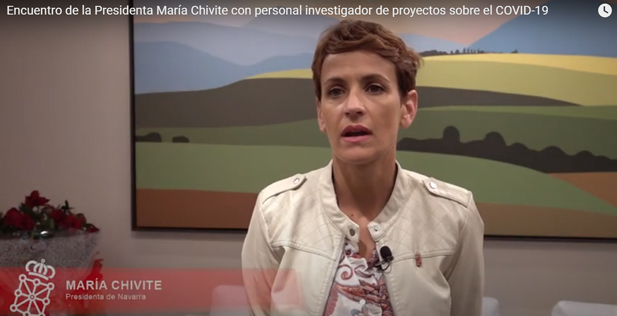
María Chivite, the President of the Government of Navarre, recognized “the good work” being done at research centers and institutes in the Region of Navarre to find alternatives that help alleviate the effects of COVID-19. She spoke in the context of a meeting she attended this morning with ten researchers in charge of their own publicly funded studies on this disease, which has caused 515 deaths in Navarre and more than 27,000 in all of Spain.

The meeting was also attended by Santos Induráin, the Minister of Health, and Juan Cruz Cigudosa, the Minister of University, Innovation and Digital Transformation, and provided a firsthand opportunity to learn about the research purpose of the projects that have received grants from the Navarre COVI+D Fund. Created by the Government of Navarre to promote research on this topic, the fund paid out €1.1 million in May to eight projects that had received a favorable assessment from the Carlos III Health Institute. The Carlos III Health Institute has also provided direct funding of €232,000 for two other Navarre research projects.

Chivite took advantage of the forum to remind the participants of the Government of Navarre’s commitment to innovation and research “as a model of economic and social development,” not just through these grants, but also by means of the R&D&i Emergency Plan, presented last week, and the Reactivate Navarre Plan / Nafarroa Suspertu 2020-2023. The Government is also committed to improving technological infrastructure and promoting supra-regional cooperation. “We want Navarre to lead the way in biomedicine because we have the talent and skills to do just that. It’s one of the strategic areas we’re working on. We have to be able to transfer knowledge and research to favor industrial and technological development,” she said, before expressing her confidence that Navarre will become “a key stop on the R&D&i map.”

Chivite confirmed that the goal of the Government of Navarre is “to keep increasing investment and setting up strong pillars for the model of growth.” Navarre will thus be prepared for future challenges of the likes of COVID-19.

Chivite informed the researchers of the public support of their research work, though “people are aware of the pressure you’re under when you’re studying this coronavirus, because of the high expectations about finding a vaccine, treatments and other aspects that could alleviate the effects of a virus that has had a major impact on our society.” She asked for respect “for the time frames, rigor and meticulousness” of the researcher’s work, and also expressed hope that this work would promote “true and instructive information” that avoids fake news and disinformation in society as a whole.
 

Ten projects

In addition to President Chivite, the meeting was attended by Rosario Martínez, the Director General for Innovation. Also attending were the researchers from the ten projects that received public funding: Luis Martínez de Morentin, Fermín Mallor Giménez, Borja Sáez Ochoa, Natalia Ramírez Huerto, Jacinto López Sagaseta, Pablo Sarobe Ugarriza, Patricia Fanlo Mateo, David Escors Murugarren, Jesús Castilla Catalán and Leyre Ruete Ibarrola, who attended in representation of Beatriz Lacruz Escalada. They were joined by the heads of the different research centers where the projects are being carried out. This group included María Rosario Luquin, the Scientific Director of  the Navarre Health Research Institute (IdiSNA), Claudio Fernández, the Director of the Lurederra Foundation, and Íñigo Lasa Uzcudun, the Director of Navarrabiomed.

The directors of the ten research projects presented their lines of research, which include the study of possible vaccines, the use of specific drugs, resource management, the development of preventive measures and products, and the analysis of incidence bearing in mind sociodemographic characteristics and other conditioning factors.

The Government of Navarre aims to promote Navarre innovation and national prominence through the COVI+D Fund grants. But the goal is also to attract scientific talent, given the fact that these grants include staff payroll expenses.

Categoría
Galería de imágenes
Meeting with President Chivite and research personnel working on ten different projects to fight the effects of COVID-19.
Download Flecha que indica descarga
Picture of the meeting.
Download Flecha que indica descarga
Left to right: Santos Induráin, María Chivite and Juan Cruz Cigudosa.
Download Flecha que indica descarga
Documentación
Vídeo
Meeting with President Chivite and research personnel working on projects about COVID-19.